




























Find free umbrella insurance quotes
Fill out our online application and get expert advice to find the right policy.


Once a policy’s limit is reached, commercial umbrella insurance provides additional coverage for liability claims made on general liability, commercial auto, or employer’s liability insurance.
Umbrella insurance provides additional liability coverage for the most expensive lawsuits. For example, if a major accident maxes out your general liability policy but you still owe money for damages, business umbrella insurance can supply funds to make up the difference.
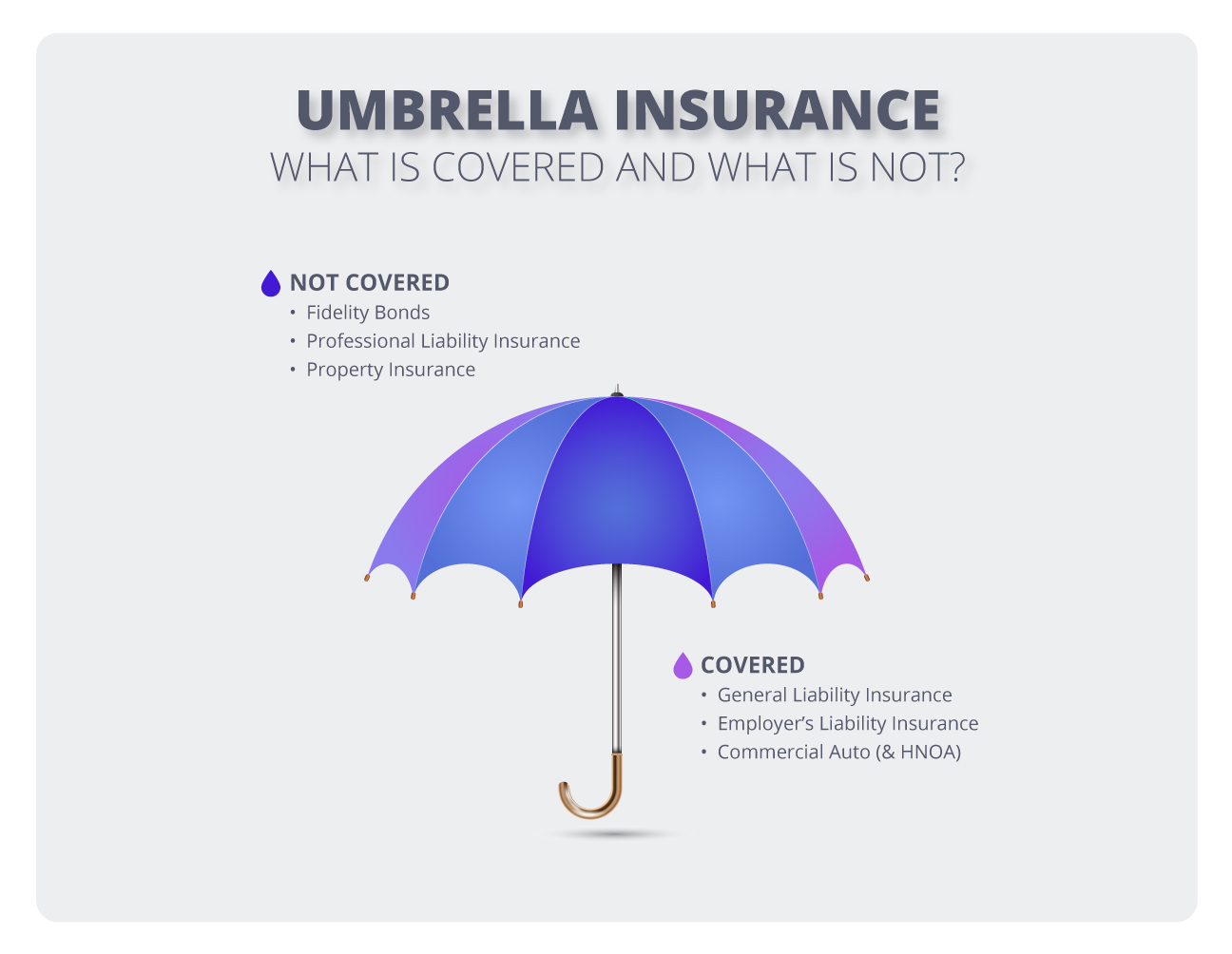
An umbrella insurance policy can supplement coverage provided by these liability insurance policies:
Commercial umbrella insurance can boost coverage for any (or all) of these policies in $1 million increments.
Business owners who purchase commercial umbrella insurance often need it to meet contract requirements that call for higher coverage limits than a standard policy provides. Many insurers cap general liability and other policies at $1 million or $2 million per occurrence, which may fall short of what clients, landlords, or partners require.
Beyond contractual needs, umbrella insurance is especially important for businesses with higher liability risks. For example, companies with heavy foot traffic, multiple jobsites, or increased exposure to accidents may face claims that exceed the limits of their primary policies. In these cases, a standard policy alone might not provide enough financial protection.
Commercial umbrella insurance helps bridge that gap by adding an extra layer of coverage across multiple underlying policies, such as general liability or commercial auto. These are often purchased as individual, or monoline, policies, meaning each type of coverage is written separately rather than bundled. Before purchasing it, however, insurers typically require you to carry a minimum level of coverage on those base policies.

Commercial umbrella insurance policies often have the same terms and cover the same risks as the underlying business insurance policy.
Specifically, umbrella insurance can help provide additional coverage for the following:

When you add commercial umbrella insurance to your general liability insurance, it can cover your legal expenses if someone falls and gets injured on your business property.
When you add commercial umbrella insurance to a general liability policy, it helps pay for legal bills related to stolen, damaged, or destroyed property that belongs to someone else.
Adding umbrella insurance to a commercial auto insurance or hired and non-owned auto insurance policy helps cover costs if someone sues for damages caused by your vehicle.
Businesses that own a company vehicle are required to carry commercial auto insurance in most states, including New York, Texas, Illinois, and California.
When you add commercial umbrella insurance to employer's liability insurance, it helps pay for employee lawsuits related to work injuries.

For Insureon customers, commercial umbrella insurance costs an average of $86 per month.
Several factors affect business umbrella insurance costs during underwriting, including:
The cost of commercial umbrella insurance depends on several key risk factors tied to your business operations, size, and claims exposure, as well as:
Hear from customers like you who purchased small business insurance.
Think of commercial umbrella insurance coverage as a safety net. Your other liability policies are your first line of defense.
When you need an extra layer of liability protection on a claim that exceeds the limits of your primary policy, your business umbrella insurance can pick up the slack.
A big claim, such as an accident that injures multiple people, could easily max out your policy and leave you paying costs out of pocket. An umbrella policy is an affordable insurance solution that can give you the peace of mind and security you need.
Let's say you have a commercial general liability policy with a $2 million per-occurrence limit, which means it can pay up to $2 million for claims from a single incident.
If a client suffers a permanent injury after tripping on a broken step at your office, the medical bills, legal fees, and damages could add up to $2.5 million. After hitting your general liability limit, you would still have a $500,000 bill.
An umbrella liability policy can help cover the expenses that exceed your underlying policy's limit. For the case above, a business umbrella policy would cover the additional $500,000.
Basically, you can make a claim on umbrella insurance when the following occurs:
Commercial umbrella insurance used to be a policy that only big businesses bought. These days, small business owners often invest in umbrella insurance due to the rising cost of lawsuits and medical expenses.
It’s also a budget-friendly way to boost your coverage limits, since an umbrella policy is often less expensive than increasing your primary policy limits.
You should consider an umbrella liability policy if:
Umbrella coverage helps close the gap on contract requirements for higher limits, typically more than $2 million.
For example, if a general contractor is bidding on a project and the contract requires a general liability policy with a $5 million per-occurrence limit, an umbrella policy of $3 million could be added to the contractor's existing $2 million general liability policy.
The more foot traffic a business has, the greater its liability risks.
For example, if a customer trips on uneven flooring at your cafe and sustains serious injuries that leave them with a chronic health problem, they could decide to sue for $3 million in damages to recoup the cost of medical expenses.
If your coffee shop's general liability policy has a per-occurrence limit of $2 million, umbrella insurance would cover damages beyond the initial $2 million, up to the umbrella policy's limits.
A business with a fleet of vehicles might want umbrella coverage to protect against the cumulative costs of minor vehicle accidents or a large multi-vehicle accident.
For example, if a window installer driving a company van to a jobsite accidentally causes a pile-up, the other drivers could decide to sue for damages.
An umbrella policy would cover the window installation business's legal defense costs once the auto policy is maxed out. It would also cover damages paid to other drivers in the form of a settlement or court-ordered judgment.
The more hazardous the work, the greater the risk of employee injury—especially in industries such as construction or installation.
For example, a long-time employee at an HVAC installation company might sue their employer over a chronic back injury caused by repeatedly lifting heavy equipment without assistance.
An umbrella liability policy added to employer's liability insurance guards against these types of employee claims, and can cover the cost of hiring a lawyer or any resulting settlement after the underlying policy's limits are reached.
While umbrella insurance expands coverage limits for a number of policies, it doesn't provide all the protection a small business might need.
For instance, an umbrella policy generally won't cover the following exclusions:

Umbrella liability insurance doesn't become active until the underlying policy has reached its limits. And, as with any policy, it doesn't provide coverage beyond its own policy limits.
Business umbrella insurance can only be added to liability policies, not property insurance.
The commercial property insurance portion of a business owner's policy (BOP) or commercial package policy (CPP) can help pay for repairs or replacement when your business property is stolen or damaged by a fire or storm.
Professional liability insurance can cover lawsuits related to mistakes, undelivered services, missed deadlines, and other instances of professional negligence. It's also called errors and omissions (E&O) insurance or malpractice insurance, depending on the industry.
You can boost the limits on this policy with excess E&O, a type of excess liability insurance that's similar to umbrella insurance.
Commercial crime insurance, including a fidelity bond, can financially protect your business if an employee commits a criminal act against your business or a client.
Unlike insurance, the amount paid out by a bond must be repaid to the company that issued it. Umbrella insurance could not be used to provide coverage beyond the bond amount.




Get answers to frequently asked questions about commercial umbrella coverage.
Businesses usually purchase an umbrella policy to fulfill contracts calling for limits of more than $2 million. Contracts of up to $5 million are not uncommon. In that case, an umbrella policy with a limit of $3 million would be added to a policy with a $2 million limit to meet the requirement.
Otherwise, the amount depends on your industry and your business needs. For example, you may want to secure more coverage for a team of construction workers, a commercial fleet of vehicles, or products that could potentially harm customers.
As you compare umbrella insurance quotes and consider your options, keep these three things in mind:
If you're unsure how much coverage you need, chat with a licensed insurance agent.
Yes, LLCs, sole proprietors, and other self-employed business owners can all qualify for commercial umbrella insurance, as long as they have the required underlying liability policies in place.
Umbrella insurance doesn’t work as a standalone policy. Instead, it extends the limits of your existing coverage, such as general liability, commercial auto, or employer’s liability insurance. If your business carries one or more of these policies, you’re typically eligible to add umbrella coverage.
For example, a self-employed contractor with general liability insurance, or a small LLC with both general liability and commercial auto coverage, can purchase an umbrella policy to increase their total protection against costly lawsuits.
As long as your business meets the insurer’s minimum coverage requirements for underlying policies, umbrella insurance is generally available—regardless of your business size or structure.
In many cases, commercial umbrella insurance premiums are tax deductible as a business expense. Because umbrella coverage is designed to protect your business from liability claims, the IRS generally considers it an ordinary and necessary expense for operating your business.
However, deductibility can depend on how the policy is used. For example, if your umbrella policy only covers business-related risks and sits on top of commercial policies like general liability or commercial auto insurance, it’s more likely to qualify as a deductible expense.
That said, tax rules can vary based on your business structure, such as an LLC or S-corp, and how your coverage is set up. If your policy includes any personal coverage or mixed-use protections, only a portion of the premium may be deductible.
To be sure you’re claiming the correct deduction, it’s a good idea to check with your insurer or a tax professional.
You may see the terms commercial umbrella insurance and excess liability insurance used interchangeably, but they’re not the same.
If you want to learn more about this policy, you can review our frequently asked questions about commercial umbrella insurance.
For any other questions about coverage, you can contact an Insureon agent.